QRKude core (C99)
A small C library that creates styled QR codes: it encodes your text, applies a style (module shapes, eyes, colors, logo, frame) and writes an SVG file or draws pixels for a screen. It is the reference implementation of QRKude: every other QRKude package either wraps it (Qt, Arduino, ESP-IDF, LVGL) or reproduces its output exactly (JavaScript, Python, Rust, Dart).
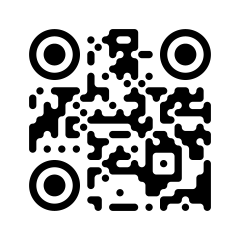
Highlights for C developers:
- No dependencies besides the C standard library and
libm. - No dynamic memory unless you ask for it (see Platform notes), so it fits microcontrollers.
- Streaming output: SVG goes through a write callback and pixels through a “span” callback, so nothing proportional to the image size is buffered.
- Builds warning-free with
-std=c99 -Wall -Wextra -Wpedantic -Wconversion, and is tested with AddressSanitizer and UndefinedBehaviorSanitizer.
Status and installation
Pre-release: there is no packaged release yet. Use it from a clone of this repository in one of three ways.
CMake (3.16 or newer):
add_subdirectory(path/to/qrkude/core)
target_link_libraries(my_app PRIVATE qrkude::qrkude)
Make (builds build/libqrkude.a, the command-line tool and the tests):
make -C coreCopy the sources: compile the files in core/src/ and add
core/include/ to your include path. That is all it needs.
For Arduino, ESP-IDF and LVGL there are ready-made packages: Arduino, ESP-IDF, LVGL.
Quick start
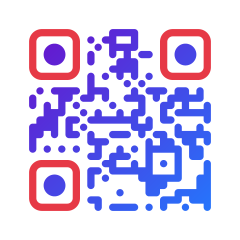
This program writes qr.svg, a QR code for https://kudelink.com with
connected round modules, a purple-to-blue gradient and round eyes.
#include <stdio.h>
#include <string.h>
#include "qrkude.h"

/* SVG output arrives in pieces through this callback */
static void to_file(void *user, const char *data, size_t len)
{
    fwrite(data, 1, len, (FILE *)user);
}

int main(void)
{
    static qrk_code code; /* about 3.9 KB: keep it off small stacks */
    qrk_style style;
    qrk_style_default(&style);
    style.modules.shape = QRK_MODULE_LIQUID;
    style.modules.paint = qrk_paint_linear(45, QRK_HEX(0x6a11cb), QRK_HEX(0x2575fc));
    style.eyes.frame = QRK_EYE_ROUNDED;
    style.eyes.ball = QRK_EYE_CIRCLE;

    const char *text = "https://kudelink.com";
    /* NULL options = defaults; NULL scratch = the library allocates it once */
    if (qrk_encode_for_style(&code, text, strlen(text), NULL, &style, NULL) != QRK_OK)
        return 1;

    FILE *f = fopen("qr.svg", "wb");
    if (!f)
        return 1;
    qrk_svg_write(&code, &style, NULL, to_file, f);
    fclose(f);
    printf("version %d, %d x %d modules\n", code.version, code.size, code.size);
    return 0;
}
Build and run it:
cc -std=c99 -Icore/include quick.c core/src/*.c -lm -o quick && ./quickNew to QR codes? Read the guide.
Styling
A qrk_style holds every option of the
style reference. Start from qrk_style_default() and
change the fields you need:
| JSON key | C field | Type |
|---|---|---|
margin |
style.margin |
double (modules) |
modules.shape / size / roundness / color |
style.modules.shape / .size / .roundness / .paint |
qrk_module_shape, double, double, qrk_paint |
eyes.frame / ball / frameColor / ballColor |
style.eyes.frame / .ball / .frame_paint / .ball_paint |
qrk_eye_shape, qrk_paint (QRK_PAINT_NONE = same as modules) |
alignment.frame / ball |
style.alignment.frame / .ball |
qrk_eye_shape (QRK_EYE_NONE = draw as modules) |
background.color / radius |
style.background.paint / .radius |
qrk_paint, double |
border.width / color |
style.border.width / .color |
double, qrk_color |
logo.* |
style.logo.size, .margin, .shape, .excavate, .background, .href |
size 0 means no logo |
label.* |
style.label.text, .font, .size, .color, .position, .bold |
text NULL or empty means no label |
Colors are qrk_color values in 0xRRGGBBAA form. QRK_HEX(0x1d3557)
gives an opaque color, QRK_RGBA(r, g, b, a) sets the alpha too. Paints are
built with qrk_paint_solid(), qrk_paint_linear() and
qrk_paint_radial(); for more than two gradient colors fill
paint.stops[] and paint.stop_count (up to QRK_MAX_STOPS).
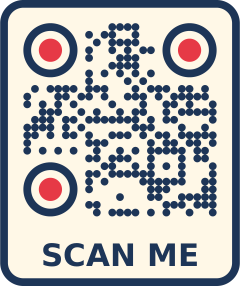
A framed code with a logo area and a caption:
qrk_style style;
qrk_style_default(&style);
style.margin = 2;
style.modules.shape = QRK_MODULE_DOT;
style.modules.paint = qrk_paint_solid(QRK_HEX(0x1d3557));
style.eyes.frame = QRK_EYE_CIRCLE;
style.eyes.ball = QRK_EYE_CIRCLE;
style.eyes.ball_paint = qrk_paint_solid(QRK_HEX(0xe63946));
style.background.paint = qrk_paint_solid(QRK_HEX(0xfff8e7));
style.background.radius = 3;
style.border.width = 1;
style.border.color = QRK_HEX(0x1d3557);
style.logo.size = 0.2;                 /* 20% of the code width */
style.logo.background = QRK_HEX(0xffffff);
style.logo.href = "logo.png";          /* used by the SVG output */
style.label.text = "SCAN ME";
Styles from JSON
qrk_style_from_json() reads the shared JSON style document. It needs a
small “arena” buffer for the strings it finds (logo URL, label text, font);
the buffer must live as long as the style.
static char arena[512];
qrk_style style;
qrk_encode_opts opts;
qrk_svg_opts svg;
qrk_style_default(&style);
qrk_encode_opts_default(&opts);
qrk_svg_opts_default(&svg);

const char *json = "{\"modules\":{\"shape\":\"dot\",\"size\":0.9},"
                   "\"eyes\":{\"frame\":\"circle\",\"ball\":\"circle\"}}";
qrk_status st = qrk_style_from_json(json, strlen(json), &style, &opts, &svg,
                                    arena, sizeof arena);
if (st != QRK_OK)
    printf("style error: %s\n", qrk_status_str(st));
Keys missing from the JSON keep their current value. In particular, when the
document has no encode.ecc, opts.ecc stays QRK_ECC_AUTO and
qrk_encode_for_style() picks M, or H when there is a logo.
Output
SVG
qrk_svg_opts svg;
qrk_svg_opts_default(&svg);
svg.width = 512;          /* write width/height attributes, in pixels */
svg.id_prefix = "promo";  /* unique per SVG when several share a web page */
qrk_svg_write(&code, &style, &svg, to_file, f);

/* or into a buffer, snprintf-style: returns the full length */
char buf[65536];
size_t len = qrk_svg_to_buffer(&code, &style, &svg, buf, sizeof buf);
The SVG is identical, byte for byte, to what every other QRKude package produces for the same style.
Pixels (displays, image files)
The rasterizer produces horizontal spans: runs of pixels with the same
color, delivered row by row. That maps directly to drawFastHLine() on most
display libraries and needs no frame buffer.
static void span(void *user, int x, int y, int len, qrk_color c)
{
    /* e.g. tft.drawFastHLine(x, y, len, rgb565(c)); */
}

qrk_raster_opts ro;
qrk_raster_opts_default(&ro, 240, 240);  /* output size in pixels */
ro.supersample = 2;                      /* anti-aliasing: 1 (off) to 4 */
ro.integer_scale = true;                 /* whole pixels per module (crisper) */
ro.clear_color = QRK_HEX(0x000000);      /* what shows outside the code */
qrk_render_spans(&code, &style, &ro, span, NULL);
Or render straight into a pixel buffer in one of seven formats (RGBA8888, BGRA8888, RGB888, RGB565, RGB565 byte-swapped for SPI displays, GRAY8, 1-bit MONO):
static uint16_t fb[240 * 240];
qrk_raster_opts ro;
qrk_raster_opts_default(&ro, 240, 240);
qrk_render_buffer(&code, &style, &ro, QRK_PIXEL_RGB565, fb, 0);
A logo bitmap for raster output goes in ro.logo as a qrk_image
(width, height, format, pixels, stride). The rasterizer trusts
these dimensions, so pixels must really hold height rows. Labels are not
drawn by the rasterizer (there is no font engine); the label area stays
background-colored.
Advice: use at least 3 to 4 pixels per module, and keep integer_scale
on for small displays. See
Size in print and on screen.
Vector geometry (QPainter, Skia, Cairo, PDF…)
To draw with your own graphics library, ask for the outline of each layer. Coordinates are in modules; multiply by your scale.
static void move_to(void *u, double x, double y) { /* start a sub-path */ }
static void line_to(void *u, double x, double y) { /* straight line */ }
static void arc_to(void *u, double r, bool cw, double x, double y,
                   double cx, double cy) { /* circular arc around (cx, cy), at most 90 degrees */ }
static void close_path(void *u) { /* close the sub-path */ }

qrk_path_sink sink = {move_to, line_to, arc_to, close_path};
for (int layer = 0; layer < QRK_LAYER_COUNT; layer++) {
    if (!qrk_layer_visible(&code, &style, (qrk_layer)layer))
        continue;
    qrk_paint paint = qrk_layer_paint(&style, (qrk_layer)layer);
    qrk_emit_layer(&code, &style, (qrk_layer)layer, &sink, my_context);
    /* fill the path with `paint`, non-zero winding rule */
}
qrk_get_layout() gives the canvas size, the position of the code, the logo
box and the label position. qrk_gradient_geometry_for() gives the exact
gradient coordinates for a layer.
Content helpers
Each helper writes a ready-to-encode text into your buffer and returns the
full length, like snprintf (so you can call it with a NULL buffer to get
the size first).
| Function | Produces |
|---|---|
qrk_payload_wifi(out, cap, ssid, password, auth, hidden) |
WIFI:T:WPA;S:...;P:...;; (auth: "WPA", "WEP", "nopass" or NULL) |
qrk_payload_vcard(out, cap, &card) |
a vCard 3.0 contact from a qrk_vcard struct |
qrk_payload_event(out, cap, &event) |
a calendar event from a qrk_event struct |
qrk_payload_email(out, cap, to, subject, body) |
mailto: link |
qrk_payload_sms(out, cap, number, message) |
SMSTO: text |
qrk_payload_tel(out, cap, number) |
tel: link |
qrk_payload_geo(out, cap, latitude, longitude) |
geo: location |
char text[256];
qrk_payload_wifi(text, sizeof text, "Kude Guest", "welcome-2026", "WPA", false);
qrk_encode_for_style(&code, text, strlen(text), NULL, &style, NULL);

qrk_vcard card = {.first_name = "Ana", .last_name = "García", .phone = "+34 600 000 000"};
qrk_payload_vcard(text, sizeof text, &card);
Making sure it scans
uint32_t warnings = qrk_lint(&code, &style);
for (uint32_t flag = 1; flag <= QRK_LINT_INVISIBLE; flag <<= 1)
    if (warnings & flag)
        printf("warning: %s\n", qrk_lint_name(flag));

double damage = qrk_logo_damage(&code, &style);  /* 0 without a logo, > 1 = unreadable */
The guide explains each warning and how to fix it.
Untrusted styles
qrk_style_from_json() is safe to use on styles from users or the network:
- documents nested deeper than 64 levels, numbers longer than 400
characters and non-finite numbers (
1e999) giveQRK_ERR_PARSE; - strings longer than the arena give
QRK_ERR_BUFFER_TOO_SMALL; - the parser does bounded work and bounded recursion on any input;
- lengths are clamped (margins, borders, label size up to 1000 modules);
- the SVG writer escapes all text, drops control characters, and reduces the
gradient id prefix to
[A-Za-z0-9_-].
Encoding options out of range (for example minVersion 0) make
qrk_encode() return QRK_ERR_INVALID_ARGUMENT.
API reference
All declarations are in include/qrkude.h.
Status and version
| Symbol | Description |
|---|---|
QRK_LIB_VERSION |
Library version string, "0.1.0" |
qrk_status |
QRK_OK, QRK_ERR_INVALID_ARGUMENT, QRK_ERR_DATA_TOO_LONG, QRK_ERR_OUT_OF_MEMORY, QRK_ERR_BUFFER_TOO_SMALL, QRK_ERR_PARSE |
const char *qrk_status_str(qrk_status) |
Readable text for a status |
Encoding
| Symbol | Description |
|---|---|
qrk_ecc |
QRK_ECC_AUTO, QRK_ECC_LOW, QRK_ECC_MEDIUM, QRK_ECC_QUARTILE, QRK_ECC_HIGH |
qrk_mode |
QRK_MODE_NUMERIC, QRK_MODE_ALPHANUMERIC, QRK_MODE_BYTE (chosen automatically) |
qrk_encode_opts |
ecc, min_version, max_version, mask (-1 = automatic), boost_ecc, eci |
void qrk_encode_opts_default(qrk_encode_opts *) |
Defaults: AUTO, versions 1 to QRK_MAX_VERSION, automatic mask, boost on, no ECI |
qrk_code |
Result: version, size, ecc, mask, mode, modules[] (bit matrix) |
qrk_status qrk_encode(qrk_code *, const void *data, size_t len, const qrk_encode_opts *, uint8_t *tmp) |
Encode bytes. tmp is NULL or a QRK_BUFFER_LEN_MAX scratch buffer. AUTO means M |
qrk_status qrk_encode_for_style(qrk_code *, const void *data, size_t len, const qrk_encode_opts *, const qrk_style *, uint8_t *tmp) |
Same, but AUTO means H when the style has a logo |
qrk_status qrk_encode_text(qrk_code *, const char *text, const qrk_encode_opts *, uint8_t *tmp) |
Encode a NUL-terminated string |
bool qrk_get_module(const qrk_code *, int x, int y) |
True for a dark module; false outside the grid |
QRK_MAX_VERSION, QRK_SIZE_FOR_VERSION(v), QRK_BUFFER_LEN_FOR_VERSION(v), QRK_BUFFER_LEN_MAX |
Size limits and buffer sizes |
Style
| Symbol | Description |
|---|---|
qrk_style |
All style options (see Styling) |
void qrk_style_default(qrk_style *) |
Black square modules on white, margin 4, no logo, no label |
qrk_color, QRK_RGBA, QRK_RGB, QRK_HEX, QRK_TRANSPARENT |
Colors in 0xRRGGBBAA form |
qrk_paint, qrk_stop, qrk_paint_type, QRK_MAX_STOPS |
Solid colors and gradients |
qrk_paint qrk_paint_solid(qrk_color) |
Solid paint |
qrk_paint qrk_paint_linear(double angle_deg, qrk_color from, qrk_color to) |
Two-color linear gradient |
qrk_paint qrk_paint_radial(qrk_color center, qrk_color edge) |
Two-color radial gradient |
qrk_module_shape, qrk_eye_shape, qrk_logo_shape, qrk_label_position |
Shape and position enums |
int qrk_module_shape_from_name(const char *), const char *qrk_module_shape_name(int) |
Convert between enum values and JSON names |
int qrk_eye_shape_from_name(const char *), const char *qrk_eye_shape_name(int) |
Same for eye shapes |
bool qrk_parse_color(const char *str, size_t len, qrk_color *out) |
Parse #rgb, #rrggbb, #rrggbbaa, transparent |
qrk_ecc qrk_recommended_ecc(const qrk_style *) |
H with a logo, otherwise M |
qrk_status qrk_style_from_json(const char *json, size_t len, qrk_style *, qrk_encode_opts *, qrk_svg_opts *, char *arena, size_t arena_len) |
Read the shared JSON document; any output pointer may be NULL |
Scannability
| Symbol | Description |
|---|---|
uint32_t qrk_lint(const qrk_code *, const qrk_style *) |
Warning flags QRK_LINT_* |
QRK_LINT_LOGO_RISKY, QRK_LINT_LOGO_UNREADABLE, QRK_LINT_LOW_CONTRAST, QRK_LINT_INVERTED, QRK_LINT_TRANSPARENT_BACKGROUND, QRK_LINT_QUIET_ZONE, QRK_LINT_SMALL_MODULES, QRK_LINT_EYE_SHAPES, QRK_LINT_INVISIBLE |
The flags |
const char *qrk_lint_name(uint32_t flag) |
"logo-risky", "low-contrast", … |
double qrk_logo_damage(const qrk_code *, const qrk_style *) |
Share of the error correction used by the logo |
Geometry
| Symbol | Description |
|---|---|
qrk_layout, void qrk_get_layout(const qrk_code *, const qrk_style *, qrk_layout *) |
Canvas size, code origin, logo box, label anchor (in modules) |
qrk_layer |
QRK_LAYER_BACKGROUND, _BORDER, _MODULES, _EYE_FRAMES, _EYE_BALLS, _LOGO_BACKGROUND |
qrk_path_sink |
Callbacks move_to, line_to, arc_to, close |
int qrk_emit_layer(const qrk_code *, const qrk_style *, qrk_layer, const qrk_path_sink *, void *user) |
Outline of one layer; returns the number of sub-paths |
bool qrk_layer_visible(const qrk_code *, const qrk_style *, qrk_layer) |
Whether a layer draws anything |
qrk_paint qrk_layer_paint(const qrk_style *, qrk_layer) |
Paint of a layer (eye colors resolved) |
qrk_gradient_geometry, void qrk_gradient_geometry_for(const qrk_code *, const qrk_style *, qrk_layer, qrk_gradient_geometry *) |
Gradient coordinates |
SVG
| Symbol | Description |
|---|---|
qrk_svg_opts, void qrk_svg_opts_default(qrk_svg_opts *) |
width (pixels, 0 = none) and id_prefix |
qrk_write_fn |
void (*)(void *user, const char *data, size_t len) |
qrk_status qrk_svg_write(const qrk_code *, const qrk_style *, const qrk_svg_opts *, qrk_write_fn, void *user) |
Stream the SVG |
size_t qrk_svg_to_buffer(const qrk_code *, const qrk_style *, const qrk_svg_opts *, char *buf, size_t cap) |
SVG into a buffer; returns the full length |
size_t qrk_format_number(double, char out[32]) |
The number format used in the SVG |
Raster
| Symbol | Description |
|---|---|
qrk_pixel_format |
QRK_PIXEL_RGBA8888, _BGRA8888, _RGB888, _RGB565, _RGB565_SWAPPED, _GRAY8, _MONO |
qrk_image |
A logo bitmap: width, height, format, pixels, stride |
qrk_raster_opts, void qrk_raster_opts_default(qrk_raster_opts *, int width, int height) |
Size, supersample, integer_scale, clear_color, logo |
qrk_span_fn |
void (*)(void *user, int x, int y, int len, qrk_color) |
qrk_status qrk_render_spans(const qrk_code *, const qrk_style *, const qrk_raster_opts *, qrk_span_fn, void *user) |
Render as spans |
size_t qrk_pixel_buffer_size(qrk_pixel_format, int width, int height) |
Bytes needed for a buffer |
qrk_status qrk_render_buffer(const qrk_code *, const qrk_style *, const qrk_raster_opts *, qrk_pixel_format, void *pixels, size_t stride) |
Render into a buffer (stride 0 = packed rows) |
Content helpers: see Content helpers; also the
qrk_vcard and qrk_event structs.
Platform notes
Memory
| Item | Size |
|---|---|
qrk_code with QRK_MAX_VERSION 40 / 20 / 10 / 4 |
3922 / 1182 / 412 / 142 bytes |
| Encoding scratch buffer | QRK_BUFFER_LEN_MAX bytes (about the size of qrk_code) |
qrk_style (64-bit build) |
808 bytes |
| Rendering | about 2.6 KB of stack on ESP32, no heap |
| JSON reader | about 1.5 KB of stack plus your arena |
Compile-time options
| Define | Effect |
|---|---|
QRK_MAX_VERSION=n |
Largest code size supported (default 40). Lower it on small microcontrollers. |
QRK_NO_MALLOC |
qrk_encode never allocates; you must pass a scratch buffer. |
QRK_NO_LOCALE |
Do not use localeconv() in the JSON reader (set automatically on AVR). |
Speed (desktop, one core): encoding a version 40 code takes about 9 ms; a version 10 code under 1 ms. Rendering 240 × 240 pixels with 2 × 2 anti-aliasing takes about 5 ms. Microcontrollers are roughly 20 to 50 times slower.
Standards: QR Code Model 2, versions 1 to 40 (ISO/IEC 18004). Micro QR and rMQR are not supported.
Development
make -C core test               # build everything and run the unit tests
core/build/qrkude --help        # the command-line tool
core/build/qrkude "https://kudelink.com" -s style.json -o qr.png -p 1024
echo -n "data" | core/build/qrkude --stdin --info --matrix

python3 spec/tools/gen_vectors.py     # regenerate the shared test cases
python3 spec/tools/check_decode.py    # decode every gallery style with zxing-cpp
See CONTRIBUTING.md for how changes flow to the other packages.
License
Apache License 2.0. See LICENSE.
This page is core/README.md in the QRKude repository.